
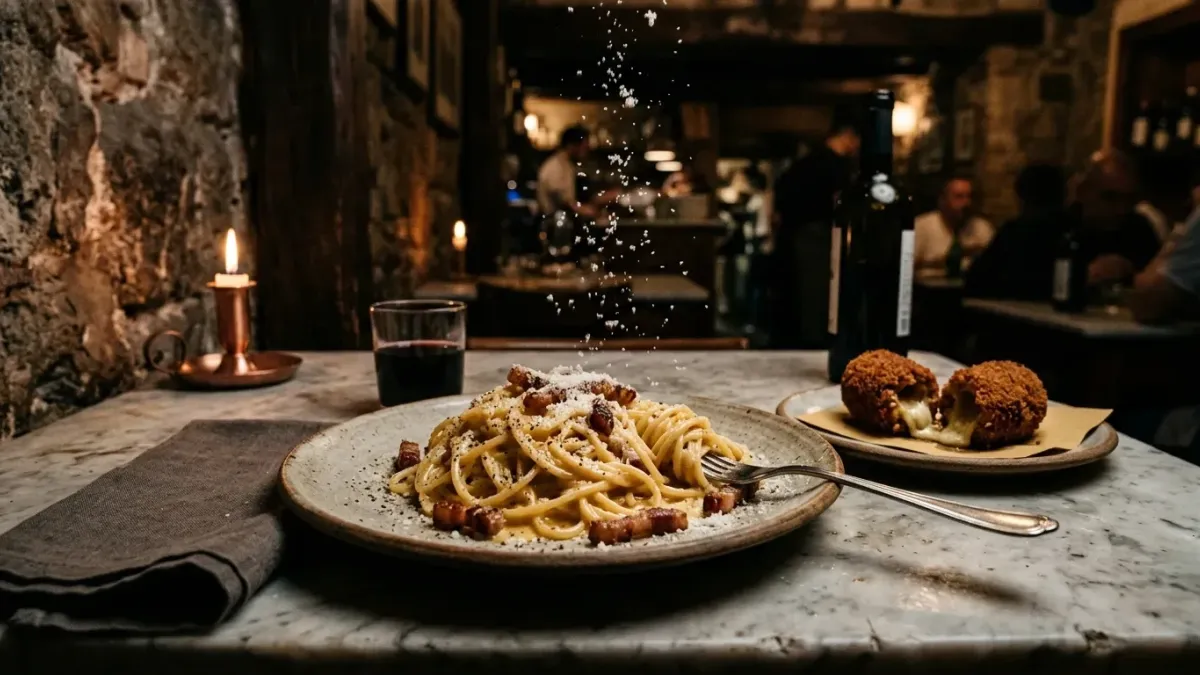
Quick answer: To get an authentic taste of Rome, skip tourist hotspots near the Colosseum and head straight to neighborhoods like Testaccio, Trastevere, and Garbatella. Focus on iconic local staples: master the four classic Roman pastas, grab fresh pizza al taglio by weight, visit morning produce markets, and embrace the evening aperitivo ritual alongside local residents.
What Is a Taste of Rome? Understanding the Capital's Culinary Soul
To truly understand the Roman palate, you must first understand the history of cucina povera (peasant cuisine). Historically, working-class Romans took simple, inexpensive ingredients—wild greens, aged sheep’s milk cheese, cured pork jowl, and fresh legumes—and turned them into rich, comforting dishes. The modern food scene still revolves around these rustic roots. Unlike northern Italian cuisine, which relies heavily on butter and cream, Roman cooking relies on extra virgin olive oil, garlic, black pepper, and sharp Pecorino Romano cheese.
Another crucial pillar of authentic Roman dining is the seasonal calendar. Locals wait eagerly for spring to arrive so they can feast on carciofi alla Romana (braised artichokes with mint and garlic) or carciofi alla Giudia (crispy deep-fried Jewish-style artichokes). Visiting during the wrong season means missing out on peak flavor, as traditional family-run eateries strictly serve produce harvested at its prime. Knowing when and where to eat is just as important as knowing what to order.
Before planning your daily meals, it helps to understand the practical logistics of visiting Italy. Most travelers enter the country via Fiumicino Airport (FCO). A direct Leonardo Express train ride into central Termini Station costs €14 ($15 USD) and takes roughly 32 minutes. Italy operates within the Schengen Zone, allowing standard tourist visas (or ETIAS entry permits for visa-exempt travelers) for stays up to 90 days. The official safety status across major Italian tourist hubs remains stable, though the US Department of State maintains a Level 2 travel advisory due to typical urban pickpocketing in crowded transit hubs. Keep your personal items secure while navigating busy street markets and metro cars.
Traveler's tip: A classic beginner mistake is sitting down for dinner at 6:30 PM. Most traditional trattorias do not open their doors until 7:30 PM or 8:00 PM, and locals rarely sit down to eat before 8:30 PM. If you show up early, you will likely end up in an overpriced tourist trap that caters exclusively to uninformed sightseers.
Planning Your Roman Food Odyssey: Logistics & Budget
Planning your culinary itinerary requires balancing your budget against neighborhood choices. Central Rome is remarkably walkable, but taking public transit saves valuable time. Single transit tickets for the ATAC bus and metro network cost €1.50 ($1.65 USD) and remain valid for 100 minutes, while a standard 24-hour unlimited pass costs €7.00 ($7.70 USD). Below is a realistic breakdown of daily travel costs for food-focused explorers visiting the city.
| Traveler Profile | Daily Budget (USD) | Accommodation Style | Typical Dining Plan |
|---|---|---|---|
| Budget Adventurer | $65 - $90 | Hostel dorm / Budget room (€35-€60) | Market stalls, pizza al taglio, street food, espresso at the counter |
| Mid-Range Explorer | $150 - $260 | Boutique B&B / 3-star hotel (€90-€160) | Coffee shop breakfast, light trattoria lunch, full evening sit-down dinner |
| Luxury Epicurean | $450+ | 5-star historical hotel (€350+) | Guided tasting tours, Michelin-starred fine dining, premium wine pairings |
Weather plays a major role in your food experience. The best months to visit Rome for optimal dining conditions are April to May and September to October. During spring (shoulder season), average temperatures hover around 18°C to 23°C (64°F–73°F) with mild rainfall averaging 40mm per month, making outdoor terrace dining exceptionally pleasant. Summer months like July and August see scorching heat above 35°C (95°F), driving many authentic family-owned trattorias to close for summer holidays (chiusura estiva).
7 Essential Food Experiences for an Authentic Taste of Rome
1. Dive into Morning Market Life at Mercato Testaccio
For an unfiltered look at daily life, bypass the heavily commercialized market at Campo de' Fiori and head straight to Mercato Testaccio (located at Via Aldo Manuzio, 66; GPS: 41.8771° N, 12.4768° E). Testaccio is widely considered the birthplace of modern Roman gastronomy due to its historical slaughterhouse district. Today, this modern covered market houses over one hundred vendor stalls selling heirloom tomatoes, aged cheeses, cured meats, and fresh seafood.
Step up to Stall 61, home to Mordi e Vai, where retired butcher Sergio Esposito serves hearty sandwiches stuffed with slow-cooked Roman stews. Try the allesso di bollito (tender simmered beef soaked in flavorful pan juices) for around €5.00 ($5.50 USD). Pair it with a freshly fried supplì—a warm rice croquette packed with ragù and a melting mozzarella center—for €1.50 ($1.65 USD). Exploring local markets provides an incredible foundation for any destination dining itinerary.
2. Master the Science of Pizza al Taglio
While Naples is world-famous for round, wood-fired Neapolitan pies, Rome reigns supreme in pizza al taglio (pizza by the slice). Baked in large rectangular steel pans inside high-heat deck ovens, Roman pizza features a light, airy, highly hydrated dough that produces a crunchy bottom crust. You order by pointing at the pan, indicating how wide a slice you want, and paying based on total weight.
Head to Gabriele Bonci’s Pizzarium (Via della Meloria, 43) near the Vatican for creative toppings like slow-roasted pork belly with wild fennel, or visit Antico Forno Roscioli (Via dei Chiavari, 34) for classic pizza rossa (crispy crust topped with sweet, seasoned tomato sauce). Expect to spend between €4.00 and €8.00 ($4.40–$8.80 USD) for a multi-slice lunch sampling different varieties.
3. Feast on the "Four Sacred Pastas" of Rome
You cannot claim to have experienced a true taste of Rome without sampling its core quartet of pasta dishes. Remarkably, all four recipes build upon one another using a shared foundation of cured pork jowl (guanciale) and sharp sheep cheese (Pecorino Romano):
- Cacio e Pepe: Spaghetti or tonnarelli tossed with freshly grated Pecorino Romano, crushed black pepper, and starchy pasta water to create a silky, emulsified sauce.
- La Gricia: Crisped guanciale combined with Pecorino Romano and black pepper—often called the white Amatriciana.
- L'Amatriciana: Crispy guanciale, San Marzano tomatoes, a splash of white wine, crushed chili flake, and finished with Pecorino Romano.
- La Carbonara: Pasta tossed with raw egg yolks, crispy guanciale, Pecorino Romano, and coarse black pepper. Authentic carbonara never uses cream, butter, garlic, or bacon!
For an unforgettable bowl of pasta, reserve a table at Da Enzo al 29 (Via dei Vascellari, 29) in Trastevere or Trattoria Da Felice a Testaccio (Via Mastro Giorgio, 29). Plan on spending €12.00 to €16.00 ($13.20–$17.60 USD) per pasta plate. Check out our guides to regional Italian cuisine for deeper regional menu breakdowns.
4. Experience the Ritual of Aperitivo in Monti
As late afternoon transitions into evening, Romans gather for aperitivo—a relaxed Social ritual designed to stimulate the appetite before dinner. Between 6:30 PM and 8:30 PM, ordering an Aperol Spritz, Campari Negroni, or glass of local Frascati wine unlocks access to complimentary light bites, ranging from seasoned olives and focaccia bites to full snack buffets.
Skip overcrowded tourist bars and head to the trendy Monti neighborhood. Grab an outdoor table at Fafiuche (Via della Madonna dei Monti, 28) for an impressive wine list accompanied by high-quality cured meats and artisan cheeses. Drinks during aperitivo typically cost between €8.00 and €14.00 ($8.80–$15.40 USD).
5. Spot Real Artisan Gelato (and Avoid Fake Tourist Bins)
Gelato is a daily requirement in Rome, but quality varies drastically across neighborhood shops. To eat like a Roman, avoid storefronts displaying fluffy, brightly colored mountains of gelato stacked high in plastic tubs. Natural gelato oxidizes and collapses under heat; real artisan shops store their gelato in covered stainless-steel canisters (pozzetti).
Look for natural colors: pistachio should look pale grayish-green, not fluorescent neon, and banana should look soft cream-white rather than bright yellow. Visit Gelateria del Teatro (Via dei Coronari, 65) or Fatamorgana (Piazza degli Zingari, 5) for clean, seasonal ingredients. A small two-scoop cup or cone typically costs €3.00 to €4.50 ($3.30–$5.00 USD).
6. Savor Offal Dishes (Quinto Quarto Tradition)
Adventurous foodies seeking a deep dive into historical food customs should sample quinto quarto ("the fifth quarter"). Historically, prime cuts of meat were sold to wealthy nobility, leaving offal and organ meats for the working-class butchers and slaughterhouse workers of Testaccio. Through culinary innovation, these humble cuts became beloved local delicacies.
Classic dishes include coda alla vaccinara (tender oxtail braised with tomatoes, celery, raisins, and dark chocolate) and trippa alla Romana (tripe simmered with tomatoes, wild mint, and Pecorino cheese). Book a table at Checchino dal 1887 (Via di Monte Testaccio, 30) to sample authentic oxtail stew paired with robust regional red wines. Entrees range from €14.00 to €22.00 ($15.40–$24.20 USD).
7. Master the Italian Coffee Code
Coffee in Rome is not a slow lounge affair; it is a quick, standing interaction at the neighborhood bar counter (il banco). Step up to the register, pay for your drink, present your receipt (scontrino) to the barista, and enjoy your drink while standing. Drinking at the counter is fast, Social, and significantly cheaper than sitting at a table.
Remember the unwritten rule of local coffee etiquette: milk-heavy drinks like cappuccino or caffè latte are consumed strictly during breakfast hours before 11:00 AM. Ordering a cappuccino after a heavy lunch or dinner is seen as a digestion faux pas; stick to a simple single shot of espresso (caffè normale) after meals. An espresso standing at the bar counter costs just €1.10 to €1.30 ($1.20–$1.45 USD).
Frequently Asked Questions
What is the most traditional dish to order for a real taste of Rome?
The single most defining dish of Roman culinary culture is pasta Carbonara or Cacio e Pepe, followed by fried artichokes (Carciofi alla Giudia) during the spring harvest. Sampling these dishes at an unpretentious neighborhood trattoria provides an immediate, authentic introduction to local flavors.
How much tipping is expected at Roman restaurants?
Tipping is not expected or required in Italy as it is in North America. Service charges (servizio) or bread and cover fees (coperto) are often automatically added to your bill. Leaving an extra €1.00 to €2.00 per person in cash for exceptional service at a sit-down trattoria is appreciated but strictly optional.
How can I tell if a Roman restaurant is a tourist trap?
Steer clear of places located right outside major monuments (like the Trevi Fountain or Colosseum) that feature multi-language menus with laminated photos, hosts actively hailing people on the sidewalk, or places offering early-bird dinner specials at 5:30 PM. Authentic spots typically have short, handwritten menus that change seasonally.
Your Actionable Next Step
If you are planning your first trip to Rome, start by picking one base neighborhood known for genuine food traditions, such as Testaccio or Monti, rather than staying directly next to the Vatican or Termini Station. Lock in your accommodation three to four months in advance, book an evening table at an authentic trattoria like Da Enzo al 29 before you fly out, and spend your first morning wandering through the Mercato Testaccio with an empty stomach and an open mind.