


Unveiling Morocco’s Magic: Your Essential Desert & Atlas Mountains Trek Guide
Ah, Morocco! Just the name conjures images of bustling souks, vibrant spices, and endless horizons of sand. But beyond the lively medinas lies an adventure that calls to the soul: a journey deep into the Sahara Desert, framed by the majestic Atlas Mountains. As a seasoned wanderer who’s crisscrossed Morocco more times than I can count, I’m here to tell you that this isn’t just a trip; it’s an immersive experience that will redefine your understanding of beauty and tranquility.
Table Of Content
- Unveiling Morocco’s Magic: Your Essential Desert & Atlas Mountains Trek Guide
- When to Embark on Your Desert Odyssey: Best Time to Visit
- How Long to Stay & Realistic Daily Budgets
- Planning Your Trek: DIY vs. Organized Tour
- The Journey Through the Majestic Atlas Mountains
- Into the Sands: Erg Chebbi & Sahara Camping
- Transportation Tips & Costs
- Safety Practices, Cultural Etiquette & Sustainable Travel
- Related Reading
Forget generic “top 10” lists. This is your practical, boots-on-the-ground guide to navigating the stunning Erg Chebbi dunes, camping under a blanket of Saharan stars, and exploring the ancient Kasbahs nestled in the Atlas foothills. Let’s dive in!
When to Embark on Your Desert Odyssey: Best Time to Visit
Timing is everything for a comfortable desert trek. You want warm days and cool, clear nights, not scorching heat or biting cold.
- Shoulder Season (March-May & September-November): This is the sweet spot! Daytime temperatures are pleasant (20-30°C / 68-86°F), and nights are cool and crisp, ideal for stargazing. You’ll find fewer crowds than peak season.
- Avoid Summer (June-August): The desert heat can be intense, often exceeding 40°C (104°F), making treks uncomfortable.
- Winter (December-February): While daytime can be pleasant, nights in the desert get surprisingly cold, often dropping to near freezing. Pack layers!
How Long to Stay & Realistic Daily Budgets
To truly savour this adventure without feeling rushed, I recommend a good chunk of time:
- Recommended Duration: Plan for at least 5-7 days to comfortably cover the journey from a major city (like Marrakech or Fes), explore the Atlas Mountains, reach Erg Chebbi, enjoy a desert trek and overnight camp, and then head back.
Your budget will vary significantly depending on your travel style:
- Budget Traveler: Expect around $40-60 USD per day. This includes shared transport (like local buses and grand taxis—shared intercity taxis), basic guesthouses (e.g., Auberge Le Festival in Tinghir for ~$25/night), and local food. Your desert tour might be a 2-day, 1-night basic camp.
- Mid-Range Explorer: For $80-150 USD per day, enjoy more comfortable private transfers or premium bus services, stay in charming riads or boutique guesthouses (e.g., Riad Ksar Ighnda near Ouarzazate for ~$70/night), and varied restaurant meals. Your desert experience might be a more comfortable or slightly longer tour.
- Note: These budgets generally apply to your time outside an organized desert tour. Most desert tours are all-inclusive for the desert portion.
Planning Your Trek: DIY vs. Organized Tour
You have two main paths to the desert:
- DIY Adventure: For experienced travelers, this offers maximum flexibility. Rent a 4×4 (around $60-100/day) or use a combination of buses (Supratours, CTM are reliable) and grand taxis to reach towns like Ouarzazate or Merzouga. From Merzouga, arrange a camel trek and overnight camp directly with local operators.
- The Organized Tour: This is often the most popular and stress-free option. Tours typically depart from Marrakech or Fes, handling all transport, accommodation (including the desert camp), and most meals. Look for reputable local agencies. Expect a 3-day, 2-night tour to Erg Chebbi from Marrakech to cost around $150-300 USD per person, depending on comfort level.
The Journey Through the Majestic Atlas Mountains
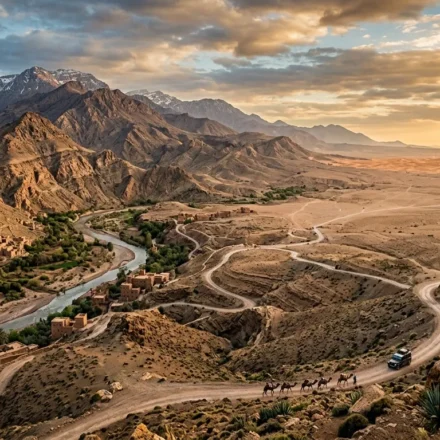
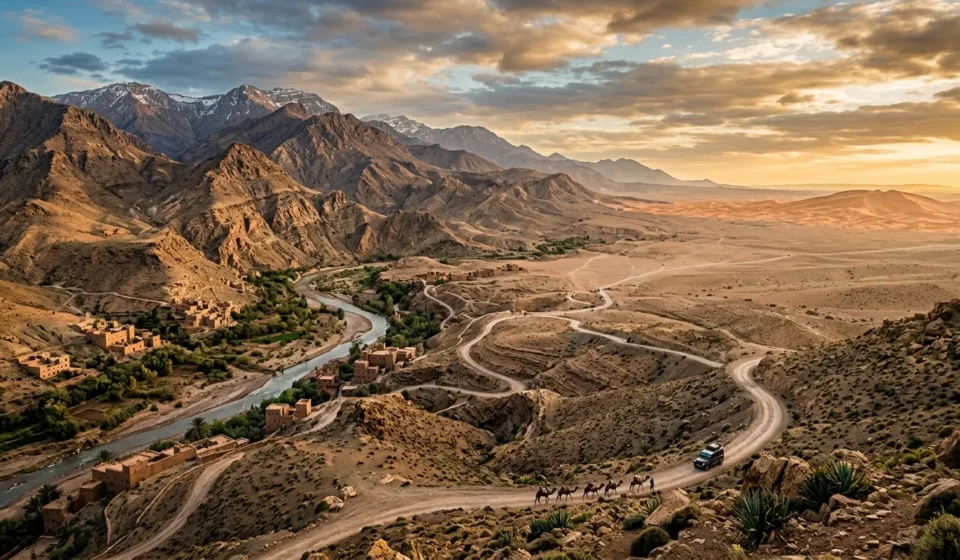
Your desert trek will likely begin with a breathtaking drive over the High Atlas Mountains. The scenery is truly epic, transitioning from lush valleys to rocky peaks.
- Tizi n’Tichka Pass: This winding mountain pass, reaching over 2,260 meters (7,415 feet), offers dramatic views.
- Hidden Gem: Ait Benhaddou! Do NOT miss this UNESCO World Heritage site. This ancient fortified village (Ksar of Ait-Ben-Haddou) is a stunning example of Moroccan earthen architecture.
- GPS Coordinates: 31.0470° N, 7.1290° W
- Insider Tip: Arrive early or late to avoid crowds. Stay overnight in a nearby guesthouse like Auberge Tiflite (around $35-45/night).
Into the Sands: Erg Chebbi & Sahara Camping
After the Atlas, the landscape transforms into the golden expanse of the Sahara, leading you to the magnificent Erg Chebbi dunes. These are the iconic, towering sand dunes you’ve dreamt of.
- Camel Trekking: Ride a camel into the dunes as the sun dips below the horizon, painting the sky in fiery hues.
- Sahara Camping: Your overnight stay in a traditional Berber-style desert camp is the highlight. Expect comfortable tents, a delicious Moroccan dinner, local music around a bonfire, and an unparalleled view of the Milky Way.
- Accommodation Example: Many camps are available outside Merzouga. For a rustic experience, look for Camp Sahara Tours (around $60-80/night). For luxury, consider Desert Heart Luxury Camp (from $150-250/night for a private tent).
- Sunrise & Sandboarding: Wake up early to witness a breathtaking desert sunrise. Many camps also offer sandboarding opportunities!
Transportation Tips & Costs
- From Marrakech to Merzouga (via bus): Supratours or CTM buses run daily. Expect to pay around 250-300 MAD (~$25-30 USD) for a comfortable, air-conditioned journey that takes about 12 hours.
- Private Transfer: For convenience, a private 4×4 transfer from Marrakech to Merzouga can cost $300-500 USD for the vehicle, suitable for groups.
- Overlanding: For true adventurers, overlanding refers to self-reliant travel to remote destinations where the journey itself is the primary goal. Renting a capable 4×4 and navigating yourself offers incredible freedom but requires solid planning.
Safety Practices, Cultural Etiquette & Sustainable Travel
Travel confidently and respectfully:
- Stay Hydrated: The desert is dry. Drink plenty of water.
- Inform Someone: If venturing out alone, always let someone know your itinerary.
- Dress Modestly: Especially when visiting towns or villages.
- Ask Before Photographing: Always ask for permission before taking photos of people.
- Bargain Respectfully: Haggling is part of the culture in souks, do so with a smile.
- Leave No Trace: This is paramount in the fragile desert environment. Carry out everything you carry in.
- Support Local: Choose locally owned guesthouses, restaurants, and tour operators.
- Conserve Resources: Water is precious. Be mindful of your consumption.
A Morocco desert trek is more than just a trip; it’s an immersion into a timeless landscape and a vibrant culture. With this guide, you’re ready to plan your unforgettable journey from the towering peaks of the Atlas to the endless dunes of Erg Chebbi. Get ready to wander, explore, and be utterly captivated by the magic of Morocco!